Deal Desk Service
Manages user Google account OAuth connections via AWS Bedrock AgentCore Identity, ingests Gmail communications, and runs a 6-stage AI intelligence pipeline that turns sales email threads into deal intelligence.
Service Overview
The Deal Desk Service (rio-deal-desk, deployed as a FastAPI container on AWS ECS Fargate alongside serverless AWS Lambda and Step Functions workers) is the core processing engine for RIO’s revenue intelligence capabilities.
It ingests Deal Desk team communications—focusing exclusively on email threads involving Deal Desk team email addresses (including internal quote approval requests, discount exception discussions, rep-to-analyst negotiations, and buyer exchanges)—with RIO’s analytics engine. It manages per-user Google Workspace / Gmail OAuth connections, ingests email threads into encrypted S3, executes a 6-stage AI enrichment pipeline (Amazon Bedrock LLMs & Nova Pro / Titan Embeddings), and serves structured deal intelligence (MEDDPPICC scoring, pricing rationale, timelines, quote revision graphs) via REST APIs.
Key Service Deliverables
| Deliverable | Description |
|---|---|
| MEDDPPICC Scorecard | Breakdown showing technical fit, champion strength, economic buyer access, and paper process status. |
| Pricing Rationale | Analysis of discount asks, competitor price pressure, and commercial trade-offs. |
| Deal Timeline | Chronological timeline of buyer milestones, legal reviews, and key email exchanges. |
| Quote Revision Graph | Tree representation of quote iterations showing historical discount escalation over time. |
| Market Pattern Insights | Aggregated buyer objections grouped by product line, deal size band, and geographic region. |
OAuth Connection Sequence
POST /authorize GET /callback Frontend ────────────────────────▶ FastAPI API ────────────────────────▶ FastAPI API │ │ (sign HMAC state, │ (verify state, │ │ call AgentCore) │ store in AgentCore, │ authorization_url │ │ update DB, publish event) │◀──────────────────────────────────┘ │ │ │ └─▶ Redirect user ▶ Google Consent ▶ AgentCore Vault ▶ Redirect Callback ──┘ │ v EventBridge: GoogleConnectionEstablished │ v Step Functions: Email Backfill PipelineHTTP API Surface (10 Endpoints)
The FastAPI application running on ECS Fargate exposes ten routes across three core operational groups:
1. Integration & Connection Lifecycle (/activity/integrations)
POST /activity/integrations/{provider}/connections/{person_id}/authorize: Initiates per-user OAuth flow. Returns signed HMAC state and Googleauthorization_urlgenerated via AWS Bedrock AgentCore Identity.GET /activity/integrations/{provider}/callback: OAuth callback endpoint handling Google redirect. Validates HMAC state, registers OAuth tokens in AgentCore token vault, updates Postgresoauth_connectiontable, and publishesGoogleConnectionEstablishedevent.GET /activity/integrations/{provider}/connections/{person_id}: Retrieves connection status (connected,connected_at, grantedscopes,error).GET /activity/integrations/google/account-summary: Returns summarized Gmail mailbox account metadata for the authenticated user.
2. Opportunity Email Threads (/activity/opportunities)
GET /activity/opportunities/{id}/email-summary: Retrieves aggregated email activity metrics and key thread indicators for a target CRM opportunity.GET /activity/opportunities/{id}/threads: Returns paginated email threads linked to an opportunity, including participant lists, message dates, and thread resolution status.
3. Deal Intelligence Serving (/activity/deal-intelligence)
GET /activity/deal-intelligence/{id}: Retrieves cached AI-generated deal intelligence from Postgresdeal_intelligencetable (cached with a 24-hour TTL).POST /activity/deal-intelligence/{id}/generate: Triggers an async Lambda worker to compute fresh AI deal intelligence for an opportunity (pricing justification, MEDDPPICC extraction, timeline, quote graph).
6-Stage Serverless Intelligence Pipeline
+-------------------+ +-------------------+ +-------------------+ | Stage 1: Ingest | ───▶ | Stage 2: Parse | ───▶ | Stage 3: Resolve | | Gmail -> S3/CH | | Bedrock Converse | | 3-Lane Resolution | +-------------------+ +-------------------+ +-------------------+ │ ▼ +-------------------+ +-------------------+ +-------------------+ | Stage 6: Serving | ◄─── | Stage 5: Synthesis| ◄─── | Stage 4: Distill | | Deal Intelligence | | Canonical/Pattern | | Claude + Titan | +-------------------+ +-------------------+ +-------------------+Stage 1 — Ingestion & Corpus (Sync Schedule & Mechanics)
- Backfill Sync: Triggered immediately upon receiving
GoogleConnectionEstablishedevent. Executesemail_backfill.asl.jsonwith 2-way parallel Map concurrency. Backfills up to 90 days (newer_than:90dquery) of historical email messages. - Scheduled Sync: EventBridge Scheduler cron (
rate 1 day) launchesemail_sync.asl.json. Fetches incremental email deltas via GmailhistoryIdcursor stored in Postgresemail_sync_state. - Corpus Storage: Raw email content is stored durably in Amazon S3 (
${DeployPrefix}-email-corpus), partitioned by tenant and date ({tenant_id}/year=/month=/day=/{msg}.json), encrypted with a dedicated per-environment Customer Managed Key (CMK) via Server-Side Encryption (SSE-KMS). - Corpus Index: Metadata is logged to ClickHouse
dd_corpus_indextable (deduplicated onexternal_id). - Attachment Pipeline: Asynchronous trigger via
EmailIngestionSucceededevent launchesemail_attachment_pipeline.asl.jsonto store attachments in S3 and log metadata in Postgresemail_attachment.
Stage 2 — Parsing
- Orchestration: Scheduled via
email_parsing_pipeline.asl.json. - LLM Engine: Amazon Bedrock Converse API (inline for under 100 artifacts, Bedrock Batch for over 100).
- 3-Level Parsing Resilience:
- Attempt 1: Parse body + all attachments.
- Attempt 2: If content filtering/size limits fail, retry with small attachments only (under 4MB).
- Attempt 3: If still failing, fallback to body-only text extraction.
- Permanent Failure: Record entry in Postgres
parsed_email_failureand emitEmailParsingFailedevent.
- Output: Parsed text saved to S3 & Postgres
parsed_email. Idempotency tracked in DynamoDBpipeline-idempotency.
Stage 3 — Attribution & Resolution
- 3a. Attribution (
email_attribution_pipeline.asl.json): Reads S3 message headers and maps sender/recipient email addresses to CRM person and account IDs usingAddressResolver. Populates ClickHousedd_fact_artifact,dd_fact_artifact_participant, anddd_fact_thread. - 3b. Resolution (
email_resolution_pipeline.asl.json): Matches email threads to CRM entities using 3 evidence lanes:- CRM Lane: Direct structural lookup (Account -> Opportunities, Products, Quotes, Regions).
- LLM Lane: Claude extracts candidate entities from text.
- Text Lane: Regex/heuristics matching SKUs, deal sizes, region codes.
- Claim Fusion: Fusion engine weighs lane confidence scores to resolve Opportunity, Product, Quote, and Region per thread.
- Persistence: Writes resolved threads to Postgres
thread_resolutionand ClickHousedd_fact_thread/dd_fact_thread_learning.
Stage 4 — Distillation & Embedding
- Orchestration:
email_distillation_pipeline.asl.json. - LLM Processing: Amazon Bedrock Claude extracts key business learnings, risks, and positive indicators per thread.
- Vector Generation: Bedrock Titan Embeddings model generates 1024-dimensional vector embeddings for each distilled learning.
- Output: Written to ClickHouse
dd_fact_thread_learningwith slice tags (product,region,deal_type,deal_size_band). EmitsEmbeddingsBatchReadyevent.
Stage 5 — Knowledge Base (Canonical Learning & Pattern Synthesis)
- 5a. Canonical Learning (
canonical_learning_pipeline.asl.json): Triggered byEmbeddingsBatchReadyevent. Performs Hierarchical Navigable Small World (HNSW) vector similarity search in ClickHouse to cluster near-duplicate learnings into canonical rows indd_canonical_learning. Retries collapse deterministically viauuid5(slice + learning_id). - 5b. Pattern Synthesis (
pattern_synthesis_pipeline.asl.json): Scheduled pipeline using Bedrock Claude to synthesize high-level business patterns per slice (product x region x deal_type x deal_size_band) into ClickHousedd_synthesized_pattern.
Stage 6 — Deal Intelligence Serving
- Trigger: Async Lambda triggered on-demand via
POST /activity/deal-intelligence/{id}/generateor GET cache miss. - LLM Reasoning: Combines CRM opportunity details, quote revision histories, and distilled email learnings using Bedrock Claude.
- Generated Outputs:
- Pricing Justification: Net ask, price drivers, discount justification.
- MEDDPPICC Extraction: Full methodology scoring (Metrics, Economic Buyer, Decision Criteria, Decision Process, Paper Process, Identify Pain, Champion, Competition).
- Chronological Deal Timeline: Visual deal milestones.
- Quote Revision Graph: Historical quote changes and discount iterations.
- Caching: Stored in Postgres
deal_intelligencewith a 24-hour cache TTL.
Data Stores & Schemas
PostgreSQL (Transactional State — RDS)
oauth_connection: Per-user OAuth connection state, tokens vault reference, granted scopes.email_sync_state: GmailhistoryIdwatermark cursor and backfill status per user.parsed_email: Body/attachment parse status and S3 object keys.parsed_email_failure: Attachment and message parsing failure audit logs.email_attachment: Metadata for downloaded email attachments.thread_resolution: Thread-to-CRM entity resolution outputs, risks, positive indicators.deal_intelligence: Cached daily AI deal intelligence results.
ClickHouse (Analytics Warehouse — dd_ Tables)
dd_corpus_index: Index of all ingested raw S3 email artifacts.dd_email_sync_run_log: Audit execution logs for sync and backfill passes.dd_fact_artifact: Per-email attribution facts (sender, account, timestamp).dd_fact_artifact_participant: Email participant mappings (To, Cc, Bcc).dd_fact_thread: Rollup metrics and resolution attributes per email thread.dd_fact_thread_learning: Thread learnings with 1024-dim Titan vector embeddings.dd_canonical_learning: Clustered canonical learnings from vector similarity search.dd_synthesized_pattern: Synthesized business patterns per product/region/deal slice.
DynamoDB & S3
- DynamoDB (
pipeline-idempotency): Stage-level idempotency lock table preventing duplicate processing across re-runs. - Amazon S3 (
prod-rio-email-corpus): Server-Side Encrypted (SSE-KMS) bucket storing raw normalized email payloads.
Observability, Event Routing & Security
Event Sources
rio.activity: Used by API endpoints, deal intelligence triggers, and pipeline failure alerts.rio.core.activity: Used exclusively by the email ingestion Lambda for audit events.
Notification Alert Routing
Ingestion failure events append detail.target_service = "rio.platform.notification" into their payload. The Notification Service EventBridge rule filters on this field and detail.event_name to route alerts to technical notification channels.
High-Level Service Architecture
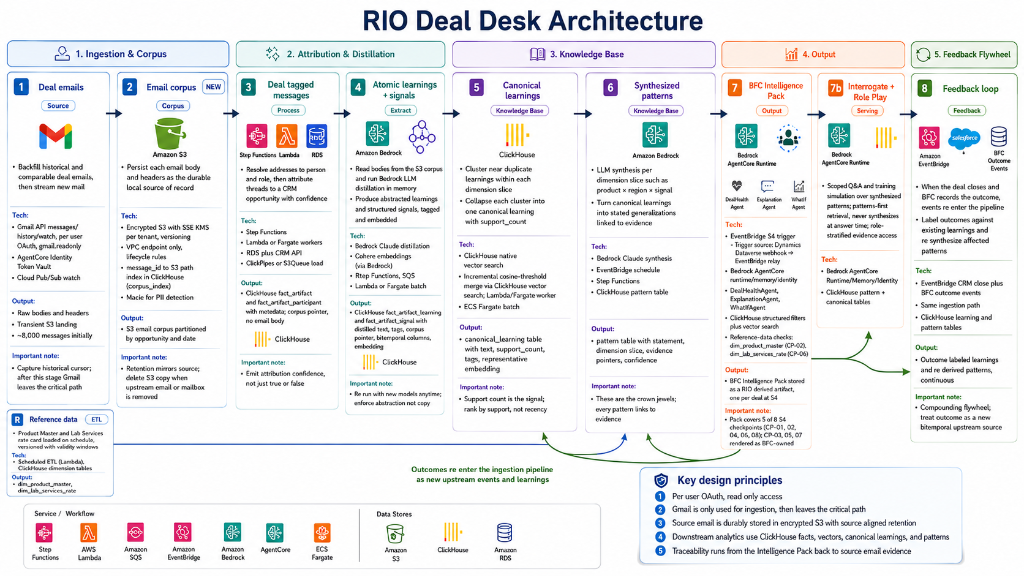
The diagram below shows the high-level architecture — Ingestion & Corpus, Attribution & Distillation, Knowledge Base, Output, Feedback Flywheel, and Key Design Principles — for the RIO Deal Desk Service.
Event Wiring (Service Message Flow)
Auto-generated view of which events this service sends and receives on the EventBridge bus.